How a mantis is put together
A head that turns, front legs that fold like a penknife and, in some, an ear in an unexpected place.
An insect, with its own order
Mantises are insects in their own order, called Mantodea. They were once grouped with grasshoppers and crickets. Amateur Entomologists’ Society: Praying Mantids (Order Mantodea) Their closest relatives are the cockroaches and termites. Natural History Museum, London: Small orders collection (Mantodea)
Mantises are medium to large insects: the Amateur Entomologists’ Society gives 10 to 200 mm long. Amateur Entomologists’ Society: Praying Mantids (Order Mantodea)
- Mantises are medium to large insects: the Amateur Entomologists’ Society gives 10 to 200 mm long. Amateur Entomologists’ Society: Praying Mantids (Order Mantodea)
- The Oxford museum gives a body length of 8 to 150 mm. Oxford University Museum of Natural History: Mantodea
- The Canadian Encyclopedia gives 1 to 15 cm. The Canadian Encyclopedia: Mantid
All three agree mantises range from small to very large; they give slightly different smallest and largest sizes. Every disagreement we found →
The head
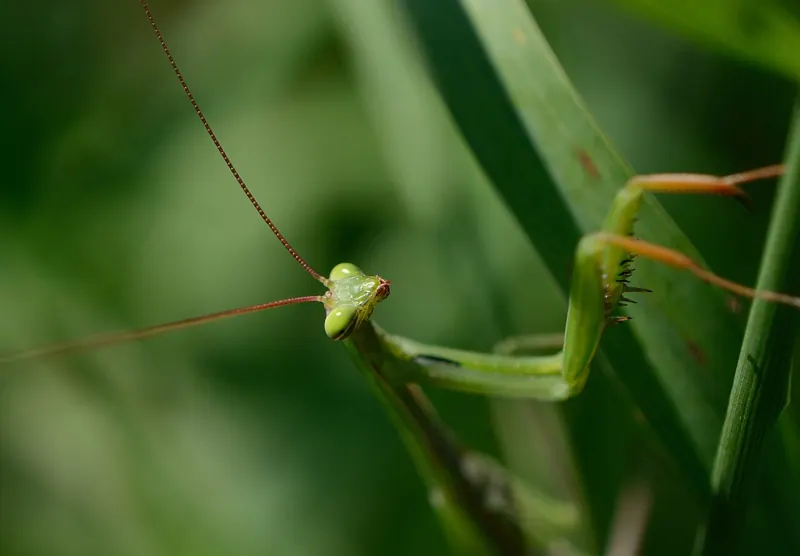
A mantis has a triangular head that can turn easily to face different directions. Britannica: Mantis With a flexible neck, mantises are the only group of insects that can look over their shoulders. The Canadian Encyclopedia: Mantid
The Chinese mantis can swivel its head 180 degrees. NC State Extension: Chinese praying mantid Their heads often turn to follow anything that moves. Australian Museum: Praying mantises (Order Mantodea)
Eyes
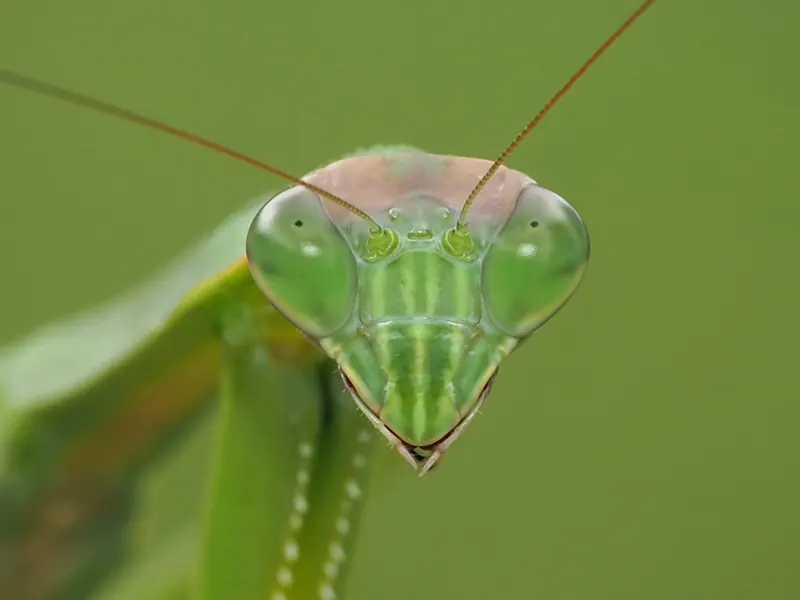
It has two large compound eyes and three small extra eyes, called ocelli. Britannica: Mantis The ocelli sit between the antennae and are used for detecting light. Britannica: Mantis
Because mantises eat almost nothing but insects, eyesight matters enormously to them, and it is unusually well developed. Britannica: Mantis
Mantis eyes can also judge distance in 3D, and scientists proved it with tiny glasses: see 3D glasses for mantises.
The front legs
The front legs are ‘raptorial’, built for seizing prey, with rows of spines on two of the leg segments. Amateur Entomologists’ Society: Praying Mantids (Order Mantodea) The spiny legs close on prey rather like the blade of a penknife closing. Amateur Entomologists’ Society: Praying Mantids (Order Mantodea)
Mantises have powerful chewing mouthparts. Australian Museum: Praying mantises (Order Mantodea)
Wings
Mantises that have wings have two pairs. At rest, the leathery front wings cover the clear hind wings, which fold like a hand fan. Australian Museum: Praying mantises (Order Mantodea)
In many species the females have no wings, or wings too small to use. Australian Museum: Praying mantises (Order Mantodea)
- Not all mantises can fly. Those that do are often drawn to lights at night. Amateur Entomologists’ Society: Praying Mantids (Order Mantodea)
- Australian mantises are weak fliers that usually fly in short bursts. Australian Museum: Praying mantises (Order Mantodea)
The Amateur Entomologists’ Society says mantises that can fly are often drawn to lights; the Australian Museum describes Australian mantises as weak fliers that go in short bursts. Both agree not every mantis can fly. Every disagreement we found →
An ear for bats
Mantises that fly at night have an ear on the underside of the body that picks up ultrasound, so they can dodge bats hunting by echolocation. Natural History Museum, London: Small orders collection (Mantodea)
The Canadian Encyclopedia describes these hearing structures as sitting beneath the hind legs. The Canadian Encyclopedia: Mantid
The back end
At the tip of the abdomen are two short ‘tails’ called cerci. Australian Museum: Praying mantises (Order Mantodea)
To tell an adult male from a female, count the segments under the abdomen: males usually have eight and females six. Amateur Entomologists’ Society: Praying Mantids (Order Mantodea)