Wait, wait, grab
Most mantises don’t chase their food. They keep still, keep watching, and strike when something comes close enough.
Most mantises are ambush predators: they wait for prey rather than chase it. Britannica: Mantis They spend a lot of time keeping still with their front legs held out, waiting. Australian Museum: Praying mantises (Order Mantodea)
Many species can run fast, especially those living on the ground, in deserts or on tree trunks. Britannica: Mantis
What they eat
Mantises eat mostly insects, but have been known to eat small animals with backbones. Australian Museum: Praying mantises (Order Mantodea) Mantises will eat prey about their own size, and bigger species will take mice, lizards and frogs. Amateur Entomologists’ Society: Praying Mantids (Order Mantodea)
The Chinese mantis eats almost any animal it can overpower, including butterflies, crickets, flies, grasshoppers, moths and spiders. NC State Extension: Chinese praying mantid
Mantises are drawn to lights at night and often sit nearby catching moths and other insects. Amateur Entomologists’ Society: Praying Mantids (Order Mantodea)
Birds, sometimes
A 2017 study found mantises of 12 species catching small birds in the wild, in 13 countries on every continent except Antarctica. University of Basel study, reported by ScienceDaily (4 July 2017): Praying mantises hunt down birds worldwide Most of the 147 cases were in the USA, often at hummingbird feeders, so most of the birds were hummingbirds. University of Basel study, reported by ScienceDaily (4 July 2017): Praying mantises hunt down birds worldwide
Hide in plain sight
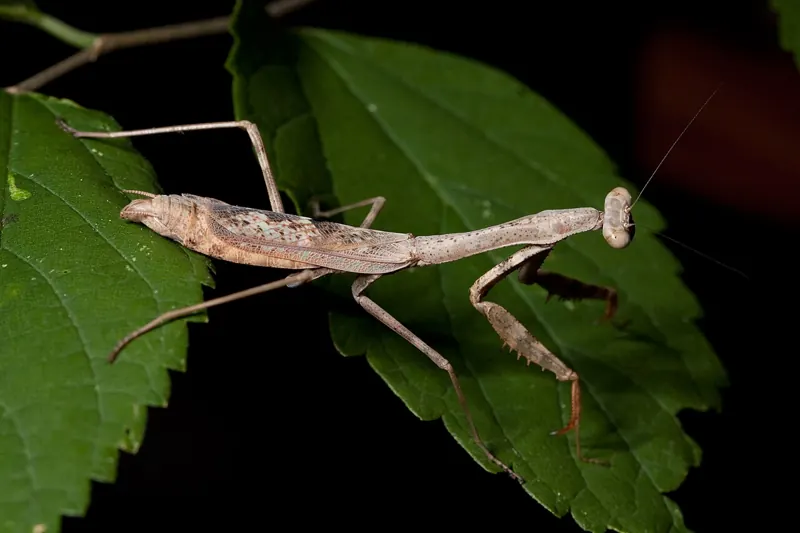
Mantises are experts at camouflage. Many look like sticks, twigs or leaves, their egg cases can look like seeds, and young ones often look like ants. Australian Museum: Praying mantises (Order Mantodea) Most are green or brown. Australian Museum: Praying mantises (Order Mantodea)
Some are disguised as a dead leaf, a lichen or a brightly coloured flower. Britannica: Mantis
Some mantises look like flowers to lure in the butterflies that visit those flowers. The Canadian Encyclopedia: Mantid Some mantises copy ants or wasps. The Canadian Encyclopedia: Mantid
When something hunts them
Mantises are food for others too: larger birds, reptiles and insect-eating mammals eat Chinese mantises. NC State Extension: Chinese praying mantid
When disturbed, a mantis usually keeps still or slips out of sight. Some put on a threatening display, give off a nasty smell or flash warning colours. Australian Museum: Praying mantises (Order Mantodea) A frightened mantis may rear up and raise and rustle its wings. Britannica: Mantis
Mantises that fly at night have an ear on the underside of the body that picks up ultrasound, so they can dodge bats hunting by echolocation. Natural History Museum, London: Small orders collection (Mantodea)
The most famous disguise of all belongs to the orchid mantis.
Next: the orchid mantis →